Agents and Lifecycle
What is an Agent?
An agent in Scarab-Runtime is a process spawned and managed by agentd. Unlike ordinary OS processes, every agent has:
- A UUID identity (
SCARAB_AGENT_ID) injected at spawn time - A lifecycle state tracked by the daemon
- A capability set derived from its manifest
- A sandbox enforced at the kernel level
- An audit trail of every action it takes
- A workspace (overlay filesystem) for isolated file operations
- A persistent memory store (SQLite-backed key-value)
- An observation log (hash-chained NDJSON)
Lifecycle State Machine
Every agent follows this state machine:
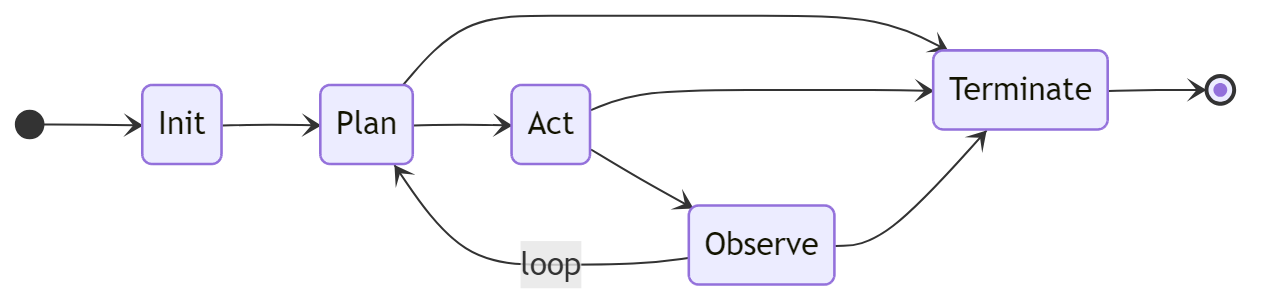
Terminate is reachable from any state except Init.
State Descriptions
| State | Description |
|---|---|
Init | Agent is being set up. Sandbox, cgroups, and capability profiles are applied. The agent binary has not yet received control. |
Plan | Agent is reasoning. Typically calls agent.plan() to declare steps, may read memory or query observations. |
Act | Agent is executing. Tool invocations are expected in this state. |
Observe | Agent is processing results. Typically calls agent.observe() to record what happened. |
Terminate | Agent is shutting down. Resources are released and the audit log entry is finalized. |
State Transitions
Agents transition by calling agent.transition(state) (via the SDK) or by receiving an IPC Transition request. Transitions are validated:
Init → Planis the first valid transition after spawnPlan ↔ Act ↔ Observeare the normal loop statesTerminatefrom any non-Initstate is always valid- Invalid transitions return an error without changing state
Operators can force a transition with ash transition <agent-id> <state>.
Agent Identity
When agentd spawns an agent, it injects:
SCARAB_AGENT_ID=<uuid>          # Agent's unique identifier
SCARAB_SOCKET=/run/agentd/agentd.sock  # Path to daemon socket
SCARAB_TASK=<text>              # From spec.task (if set)
SCARAB_MODEL=<model-id>         # From spec.model (if set)
The agent binary reads these with std::env::var or the Agent::from_env() SDK helper.
Agent Hierarchy
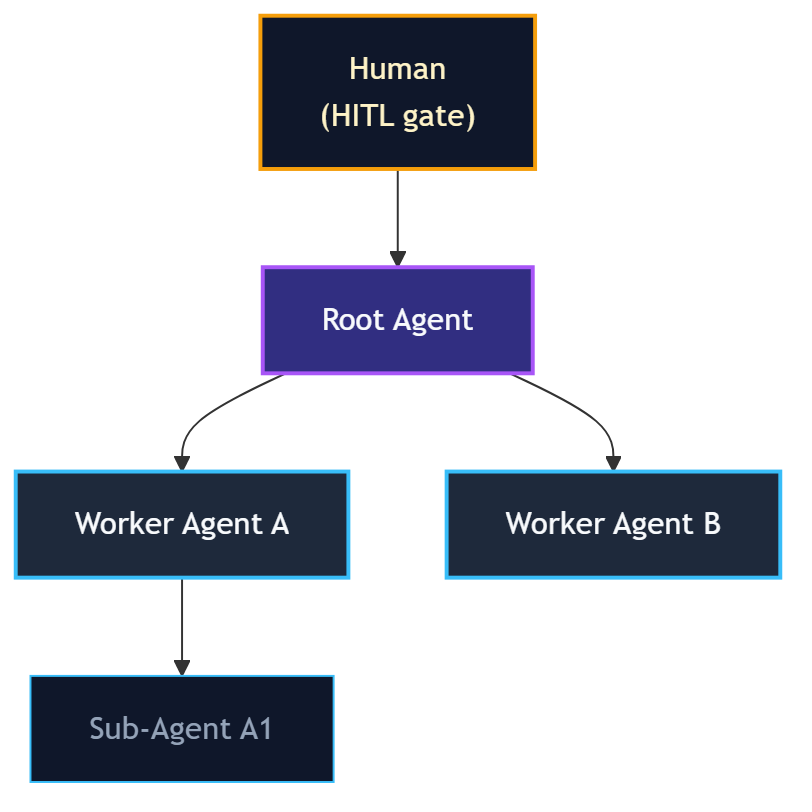
Agents form a tree. The agent that spawns another becomes its parent. Escalations (capability requests, anomaly alerts) travel up the tree. The root agent escalates to the human HITL gate.
Discover Agents
Agents can discover each other by capability pattern:
ash discover <agent-id> "bus.*"
This finds all running agents that have any bus.* capability.